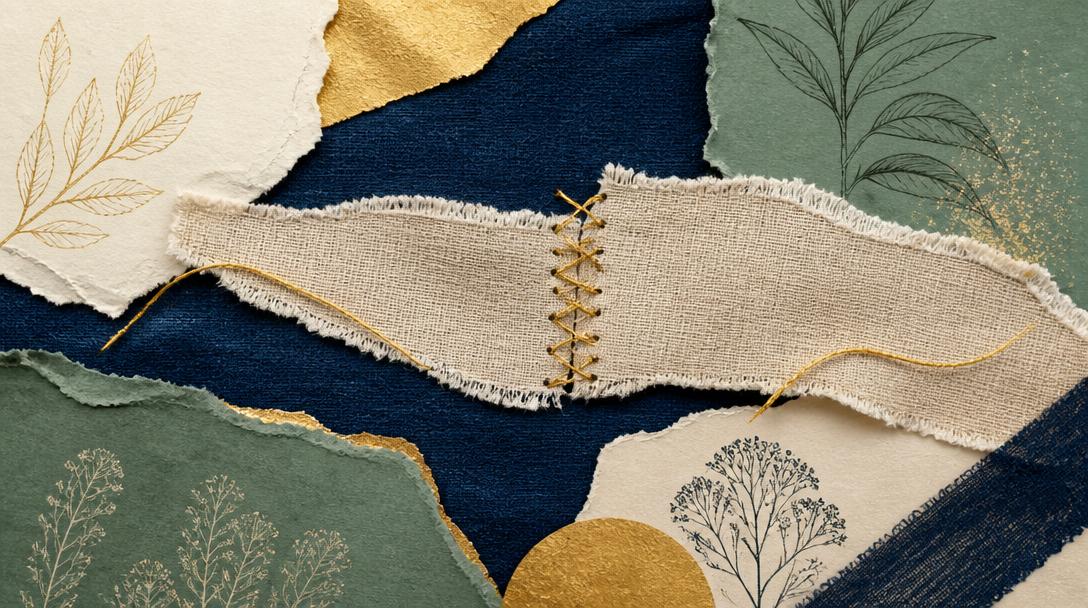
We are, all of us, clumsy weavers. In the daily choreography of living together, with spouses, children, friends, and colleagues, we drop threads. We snip connections in moments of fatigue, impatience, or blind self-protection.
For a long time, we were taught that the magic words to fix a torn fabric were simply: "I'm sorry."
We treat the apology like a coin dropped into a vending machine, expecting a clean release of forgiveness on the other side. But if you have lived long enough, you know the painful truth: an apology alone often feels like a polite exit strategy. It is a verbal wave of the hand meant to clear the air without ever actually touching the wound.
Apology is an impulse. Repair is a skill.
An apology looks backward at the spill; repair rolls up its sleeves and grabs the mop. An apology asks to be excused; repair asks how to re-architect safety. If we want relationships that endure the inevitable storms of human imperfection, we must stop viewing mending as a solemn formality and start practicing it as a lifelong craft.
What the Science Is Showing Us
In recent years, researchers in relational psychology and neuroscience have confirmed what wise souls have long sensed: the strength of a bond is not measured by the absence of conflict, but by the swiftness and quality of its repair.
Dr. John Gottman’s decades of research into intimate relationships revealed that the most resilient couples do not possess a magic immunity to arguments. Instead, they master what he calls "repair attempts," small, often clumsy verbal or nonverbal bids to de-escalate tension before the nervous system goes into full-blown panic. It might be a gentle touch on the shoulder, a self-deprecating smile, or simply saying, "Can we pause? I’m feeling overwhelmed."
Neurobiologists like Dr. Ed Tronick demonstrated that human connection naturally oscillates between mismatch (rupture) and resolution (repair). When a rupture occurs, our primitive nervous system perceives the relational disconnect as a threat to survival. A hasty "I said I'm sorry, okay?" does nothing to soothe a flooded nervous system. Real repair requires what clinical researchers call co-regulation; the deliberate, embodied work of bringing each other back to a state of safety.
Furthermore, a 2025 systematic review on trust repair by Alessia Giacobbi and Fanny Lalot emphasizes that restoring damaged trust, especially after deeper betrayals, demands far more than a statement of regret. It requires five active, ongoing dimensions: proactive transparency, active monitoring, genuine remorse, shared restorative activities, and clear communication of underlying causes.
Notice the active verbs: transparent, monitoring, sharing, communicating. Repair is not a passive noun; it is an active, structural verb.
The Four Disciplines of Relational Repair
If repair is a skill, then like woodworking or gardening, it can be practiced and refined. Here are the core disciplines that transform a hollow apology into genuine restoration:
1. Regulation Before Resolution
You cannot mend a heart while your own body is in fight-or-flight. When physiological arousal spikes, heart rates climbing above 100 beats per minute, our capacity for empathy diminishes. The first skill of repair is knowing when to call a 20-minute timeout to breathe, lower your shield, and return to curiosity rather than defensiveness.
2. Acknowledging Impact Over Intention
The sentence "I didn't mean to hurt you" is one of the most subtle ways we protect our ego at the expense of our partner's reality. Skilled repair pivots from intention to impact: "I hear how deeply my words cut you, and I am taking responsibility for how they landed, regardless of what I intended."
3. Catching the Micro-Bids
Repair work happens in real-time micro-moments. When your partner offers an olive branch, a soft tone, a cup of coffee, a quiet attempt to reconnect, the skilled repairer recognizes the bid and reaches back. Rejecting a repair attempt out of pride or spite prolongs the rupture unnecessarily.
4. Proactive Transparency and Rebuilding
As Giacobbi and Lalot note, trust isn't restored by words alone; it is rebuilt through predictable, visible patterns over time. Repair asks: "What structural changes can I put in place so this rupture does not repeat itself?"
The Grace of Broken Places
There is a quiet beauty in a mended dish, a concept the Japanese call Kintsugi, where broken pottery is rejoined with gold lacquer. The bowl becomes stronger and more striking at the fracture lines than it ever was when flawless.
Relationships operate by the same grace. A life without ruptures is an illusion; a life with skilled repair is a masterpiece.
The next time you cause a tear in the fragile fabric of someone you care about, resist the urge to offer a cheap, transactional apology. Take a deep breath. Step across the divide. Ask, "How can I help us stitch this back together?" And then, with patience, humility, and practice, begin the work.
Footnotes
John Gottman and Julie Schwartz Gottman, The Seven Principles for Making Marriage Work: A Practical Guide from the Country's Foremost Relationship Expert, 2nd ed. (New York: Harmony Books, 2015), 45–52.
Edward Z. Tronick, "Dysregulated Interactions and Repair in the Infant-Caregiver Dyad: Implications for Development," Developmental Psychology 25, no. 1 (1989): 85–92.
Alessia Giacobbi and Fanny Lalot, "Unpacking Trust Repair in Couples: A Systematic Literature Review," Research and Practice in Couple Therapy 4, no. 1 (2025): 1–14.
John Gottman, What Makes Love Last? How to Build Trust and Avoid Betrayal (New York: Simon & Schuster, 2012), 112–118.
Dr. Steven S. Steele offers private, in-person or on-line counseling for couples, individuals, and professionals in Los Altos, CA.